The Forest welcomes students
The University of Tasmania continues its commitment to sustainability with this
timber-rich re-imagining of the old Forestry Building.
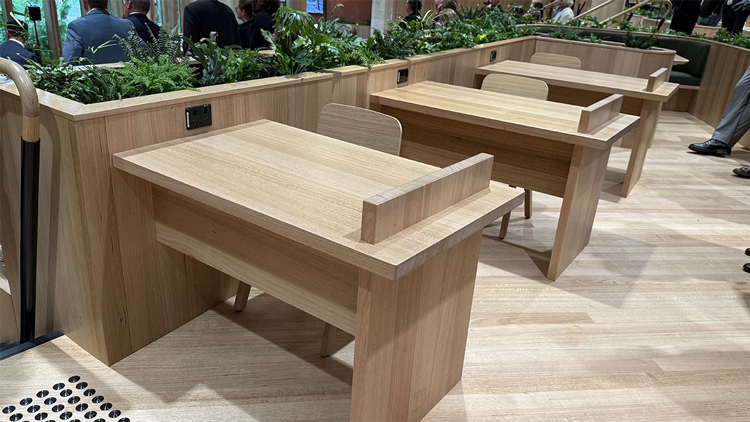
Timbers were sourced from multiple local suppliers, including Britton Timbers.
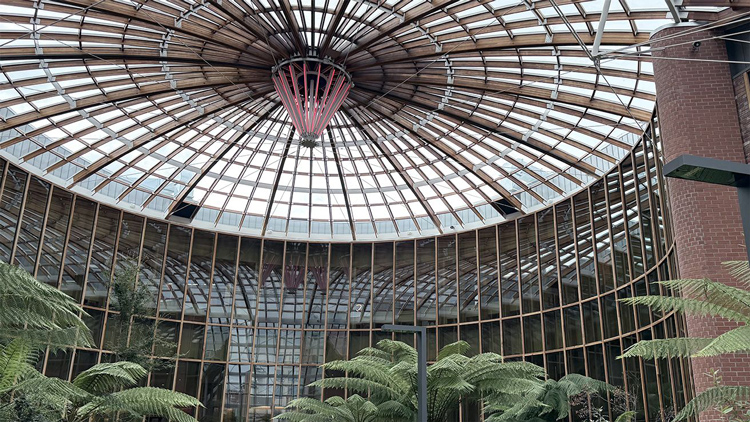
A living forest is growing beneath the dome in The Forest’s atrium.
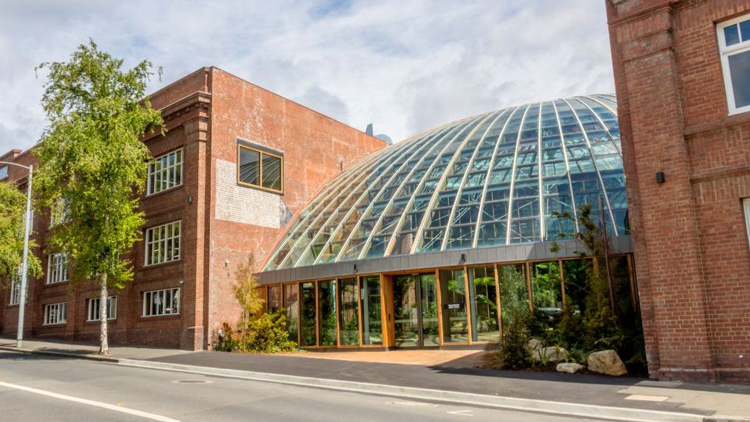
The Forest is part of an educational precinct that reuses 60% of the old warehouses already on site, resulting in 40% less embodied carbon than in a comparable building.
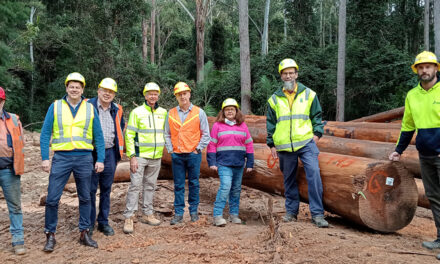
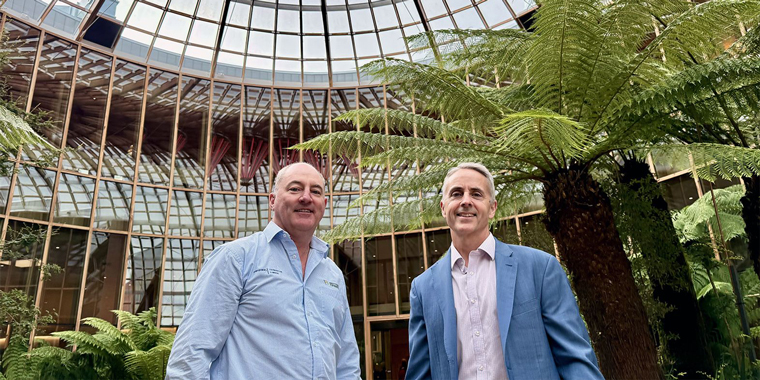
MAIN PIC: Britton Timbers MD Shawn Britton (left) with TFPA CEO Nick Steel.
All images: Australian Forest Products Association (AFPA)
Delegates and members of the Australian Forest Products Association (AFPA) and Tasmanian Forest Products Association CEO Nick Steel were among the first to journey through The Forest last Friday, as part of the official launch of the new timber-focused University of Tasmania building in Hobart.
For the past four years in a row, the University of Tasmania has been rated as the number one university in the world on climate action, having made a commitment to world-leading sustainability outcomes. The Forest delivers on this commitment.
A landmark $131 million restoration project, The Forest is a new study precinct that provides cutting-edge and accessible facilities for students and staff, as well as a regenerated living forest beneath the heritage entry dome.
Previously, the heritage-listed complex on Hobart’s Melville Street was known as the Forestry Building and had been home to Crisp & Gun, who used it for offices and a dry timber store and sawmill, and, later, Forestry Tasmania. During the latter’s tenure, a 22-metre dome-shaped conservatory was built, with large Oregon and hardwood trusses salvaged from other parts of the building for the construction. This indoor forest home won multiple awards in 1997–98.
Sadly, within 20 years the plants were gone and parts of the design could have been lost forever, until the University of Tasmania stepped in and bought the building in 2018.
The planning and design process took a long time, with the university’s sustainability concerns driving many of the decisions. However, the result has been very much worth the wait.
Designed by Woods Bagot with landscape architecture by REALMstudios, the reimagined Forestry Building on now offers a superb classroom and interactive study experience that prioritises on-campus teaching, with spaces for presentations, seminars, large or small classes, group study sessions, and studying with friends.
Goals included re-using much of the original fabric of the buildings. This one was very much scored with 60% of the existing structures being retained. This, plus an emphasis on materials such as timber and hempcrete, resulted in a 40% saving in embodied carbon on a similar new build. Locally sourced timber structures and products were prioritised, including PEFC-certified timbers from Britton Timbers.
Additionally, the new structures are demountable, allowing for reconfiguration if the university’s needs change. It’s currently the southern home to the university’s schools of Humanities and Social Sciences, Business and Economics and Social Work, as well as University College, the Tasmanian Policy Exchange, the Peter Underwood Centre for Educational Attainment, and Higher Degree by Research students, and teams of professional staff.
The entry dome on Melville Street has been brought back to life with Tasmanian forest plants and is open to the public, with access through the building to Brisbane Street. While 300 staff and up to 3000 students will be officially based in The Forest, all students and the community are welcome to use the precinct’s 300 study seats as a hub.
Next to the dome, space has been created for local businesses, industry and government to engage and collaborate with university students and staff.
Vice-Chancellor Professor Rufus Black said The Forest would provide access to enhanced learning experiences and job opportunities for Tasmanians: “With more students working throughout their studies, and more jobs in the future requiring tertiary education, The Forest provides a conveniently located hub to study and grow.
“It’s a place for the community to experience their university, either as visitors or as students. This is where students, staff, businesses, and community members can share ideas and experiences in a welcoming and accessible space for all.”