Concerns ignored
Dr John Raison has delivered expert criticisms of the INFM.
In reply: silence.
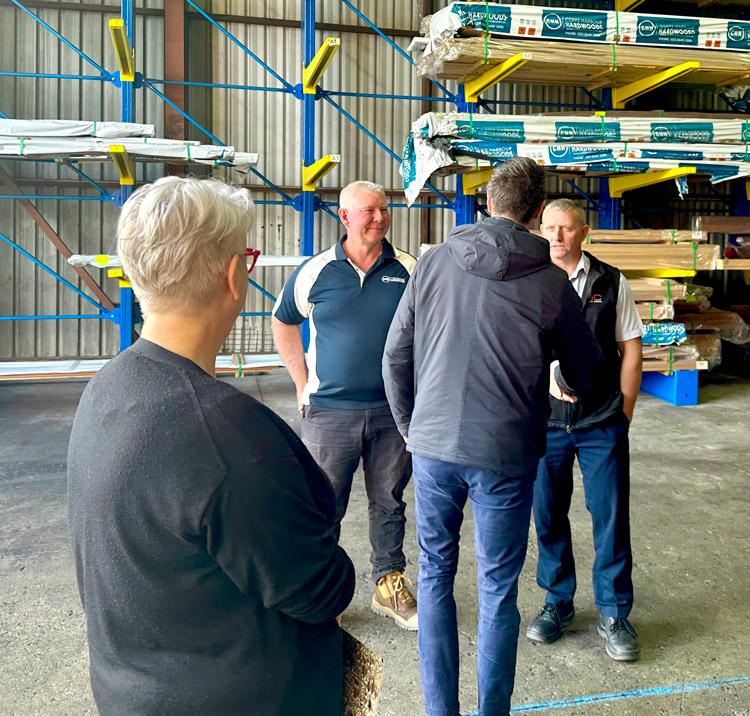
From left, NSW Environment Minister Penny Sharpe, Coffs Harbour Hardwoods’ Shane McCarthy, Premier Chris Minns and Martin McCarthy during last year’s site tour at CHH when the Premier assured the NSW native timber industry he was listening to their concerns, before massively cutting supply. Image: CHH
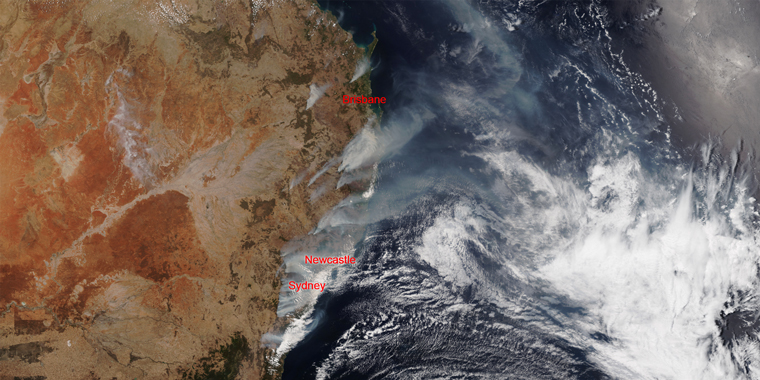
MAIN PIC: Smoke from the NSW, Victoria and Queensland bushfires detected by satellite during Black Summer. Dr Raison worries unmanaged forests will lead to more huge fires. Image: NOAA/NESDIS (public domain)
 Dr John Raison has studied the ecology of Australia’s native forests for over 40 years, with a particular interest in forest carbon cycling and how it is impacted by harvest and fire. A former chief research scientist at CSIRO, he has spent his career supporting evidence-based policy.
When it comes to the Improved Native Forestry Management ACCU method (INFM), he is very clear: “The science tells us it won’t create valid credits.”
One of a series of experts speaking out against the method, Dr Raison has written to Minister for Climate Change Chris Bowen twice in recent months outlining his concerns with the INFM. In those letters, he has clearly spelled out the issues with the method: its lack of a full and accurate life-cycle analysis of forest carbon stocks; the low precision of the FullCAM model used to estimate changing carbon stocks in native forests; the lack of verification processes for model predictions; the lack of a reliable baseline harvest level within the model the INFM relies on and fact that leakage is poorly addressed and significantly underestimated within the method.
In his second letter, Dr Raison set out his concerns that the INFM will lead to “bogus” carbon offsets, saying: “The Forestry Australia assessment found that in relation to within-forest carbon stocks, over-crediting may be of the order of 50-100%. This is excluding either carbon stored in wood products or leakage which will also markedly erode estimated credits. The treatment of leakage within the INFM is totally inadequate and does not reflect either scientific principles or information based on imports of wood products and their sources.”
Enews asked Dr Raison what response he had received from the Minister.
“Nothing directly,” he says.
“They’re remaining pretty silent on it ahead of this disallowance motion that’s coming up on the 18th of August – next week. It’s all quite politically charged: it looks as though it will be the Greens with the balance of power in the Senate who will determine whether that disallowance motion is successful or not.”
He points out that in addition to push back from the forest industry, many conservation groups have also come out against the INFM and are urging the Greens not to support it. “The science tells us it won’t create real credits,” he says. “So both the Federal and NSW Governments are remaining quiet while they wait for the outcome of next week’s motion.”
POOR ADVICE
Raison questions the advice that led to the approval of the INFM by the Emissions Reduction Assurance Committee (ERAC). “They don’t really have a strong science capability themselves,” he says, “but they often lean on the advice from within the department, including from the clean energy regulator, and I think that’s what they argued they did this time.
“Additionally, they went out to Griffith University for an ‘independent’ review, but Griffith is linked to the carbon set at ANU, which is all a bit incestuous.”
He notes that the public consultation feedback also contained multiple negative commentaries about the INFM from both timber industry and research experts, and from environmentalists.
“In my letters and elsewhere, I’ve argued that you need to do a full life cycle analysis of the carbon balance of a harvested forest,” Dr Raison says. “You have to look at what happens in the forest, what happens to the wood products, the substitution of wood for high emissions materials like steel and concrete and so on. There is also this question of leakage: if you stop production, then it goes somewhere else, and you have to account for the emissions from that.”
The manner in which the FullCAM model is applied is insufficient, he argues. “FullCAM really looks at only a part of that. It looks at what happens in the forest and what happens in the products that come out, and that modelling is under challenge.”
Raison says, “The native forest is a very complex thing to model in terms of disturbance and what happens to the carbon there. You’ve got a whole range of mixtures of species, forest structures and site conditions. It’s a very heterogeneous beast, so modelling it isn’t easy.
“And one of the things that happens if you harvest is that you get two responses that have to be modelled. First of all is what happens to the trees left behind? It’s like a thinning response. They’ve got less competition and more resources, and so we expect them to grow faster. The second thing is you have a cohort of new regenerating trees coming up, so you have to model those as well. The two need to be modelled together, and that’s pretty complicated. Some of us would argue that the current FullCAM model isn’t up to it. It hasn’t really been properly evaluated and tested against field data.”
He points to Forestry Australia’s commentary on the over-crediting likely to result from the INFM’s clearfall harvesting assumptions in FullCAM (see Enews #910), and the risk of creating fictitious carbon credits using the method.
“Then there’s the additionality question,” says Dr Raison. “There’s nothing new or additional about those forests that NSW in particular claims are being taken away from harvest. It’s long been a promise from the NSW government that the Great Koala National Park (GKNP) would be established.
“Now that government is saying, ‘If the method doesn’t get up and we don’t get the revenue from carbon credits, then the GKNP won’t go ahead.’ I don’t actually believe that, but it’s a pressure point argument not an evidence-based one, isn’t it? There’s no science that really tells you it will do anything for koalas, let alone carbon abatement.
“The whole point about Australian Carbon Credit Units is that they should be additional. They should be things that would not have happened anyway, and that change becomes the basis of the ACCU being issued. But clearly, here you’ve got a long-running promise to establish the park. Then you’ve had a moratorium there, which is already causing industry reductions and loss of jobs. So you can’t say now that, if it becomes a carbon project, it’s additional: it was already entrained.”
SCIENCE LEADS ELSEWHERE
Enews asked Dr Raison if decades of cutbacks at the CSIRO and other State and Federal science bodies had led to a situation where it was harder for government agencies to give good advice to ministers as they lacked the expertise to dissect complex issues.
“You’re absolutely right,” he says. “I think, certainly, the forest science capacity has dropped in the CSIRO as well as in the state agencies that used to be quite strong. It is a weaker science base.
“There has been quite a lot of research, though, that’s relevant to the topic, so we know what’s needed, and we know roughly how to do it.”
He points to the multiple associations and agencies, including Forestry Australia, AFWI and more that have been supporting well-grounded research in the issues surrounding native forestry, but bemoaned the fact that research receives little coverage.
“We wrote a paper that came out earlier this year about a lot of the criticisms commonly pointed against forestry, and almost all of them are wrong,” Dr Raison says (click here to download the article, first published in Australian Forestry).
“If you actually look at the science and analyse it properly, those criticisms are all based on furphies. Yet they are repeated. It’s all very political. There are certainly organisations that have ongoing campaigns to stop harvesting of native forests and this is playing into their hands.”
In 2024, Raison published ‘A review of the impacts of sustainable harvesting, non-harvest management and wildfire on net carbon emissions from Australian native forests’ in Australian Forestry, which flagged the poor application of life cycle carbon assessments in Australian native forestry research.
He wrote: “Changes to C [carbon] stocks in Australian native forests are driven much more by extensive wildfire than by harvesting” and noted that the carbon in annual log harvests equated to only about 0.6% of Australia’s total net anthropogenic greenhouse-gas (GHG) emissions, rising to 0.8% if you added emissions from the decomposition or combustion of slash produced during harvest, both of which were offset by carbon sequestration in new and regrowth, as well as wood products.
In contrast, the carbon emissions of the ‘Black Summer’ 2019/20 fires were about twice Australia’s total annual anthropogenic GHG emissions.
Dr Raison’s abstract concluded: “When examined at the landscape scale, there is no evidence that harvesting leads to increased area burnt, fire severity or C emissions caused by wildfires. However, future wildfires in the large and contiguous areas of thick regrowth created after Black Summer pose a major threat to C stocks in all forests in the coming decades.”
With the acceptance of the INFM by ERAC, Dr Raison worries that native forests face a future of much less management.
“One of the things about the INFM is 100 years of permanence. But what are the chances that a forest won’t get burnt down in the next 100 years? Pretty low, probably, particularly if they’re not actively managed.
“We have 130 million hectares of native forests. My great concern is that it will be locked away and not managed, and then just go up in smoke.”
He emphasises that he is not against ACCUs in general and notes that a better method has been proposed by Forestry Australia. “It wouldn’t just look at the effects of harvesting or withdrawing harvesting, it would look at native forests overall, including those which are in conservation. A lot of the forests that have gone into the conservation reserve network were previously disturbed forests. They were harvested or they’ve been burnt, and they’re regrowing. So there’s quite a big carbon sink that’s probably occurring in the conservation forest as well.
“They’ve proposed a method that captures that, as well as actions within the wood production native forest that could improve the carbon sink. For example, there are areas that have been burnt too often, where they haven’t regenerated well, such as in the alpine ash forest. They could be rehabilitated and you would get extra carbon sink created there.
“There’s certainly potential to develop alternative methods that will be more widely applicable and don’t just focus on ceasing harvesting.”