Alison Penfold fighting for timber
The National MP for Lyne has been a staunch defender of the sector and
an even stronger opponent of the INFM.
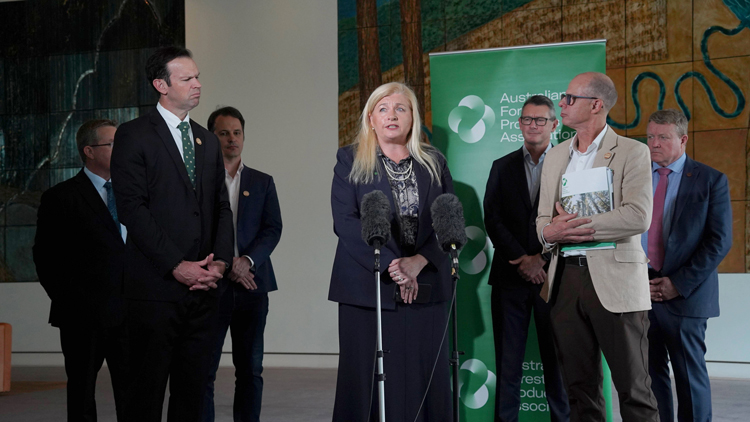
Alison Penfold with Nationals Leader Matt Canavan (left) and AFPA’s Richard Hyett at National Forestry Day this year.
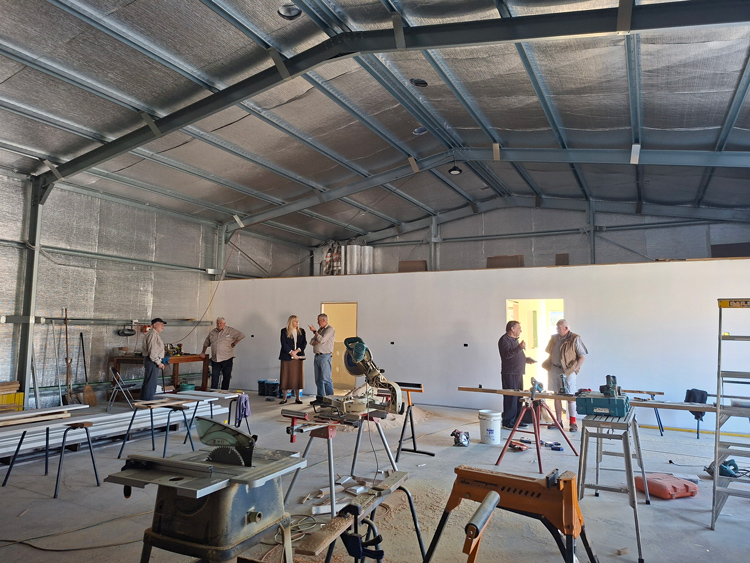
The timber industry is central to the electorate of Lyne, from reliable jobs that support the community to supporting community ventures including the Bulahdelah Men’s Shed.
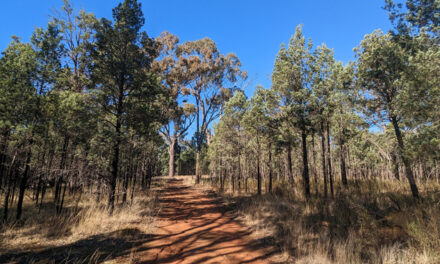
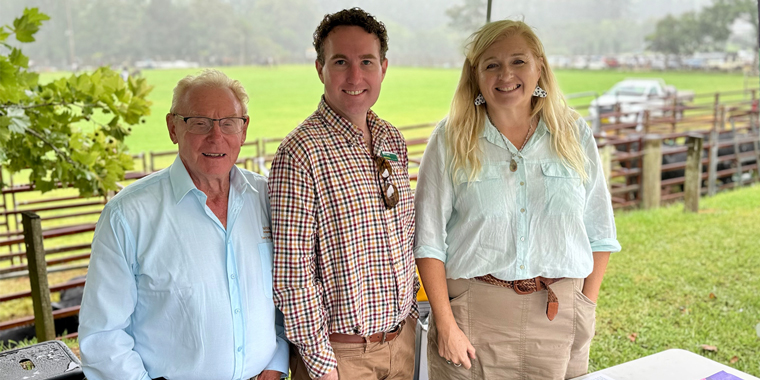
MAIN PIC: Alison Penfold MP (right) with her team at a mobile office in her electorate. Getting out into the electorate has made clear the impacts of forestry closures. All images: supplied
Alison Penfold, Federal MP for Lyne, has a long history of standing up for the forestry industry in her electorate and beyond. Recently, she made an impassioned statement in the House of Representatives about the impacts of the Improved Native Forestry Management (INFM) method on timber workers (see Enews #916) before the disallowance motion was voted down.
Enews spoke with Penfold last week on the INFM’s impacts, which are already being felt by locals in the Wauchope region thanks to the native forestry harvesting moratorium in the wake of last year’s Great Koala National Park announcement.
“We had workers hauled in at Herons Creek mill and the initial round of redundancies,” Penfold said. “And then the green mill shut. It was a pretty big mill, 10 kilometres from where I live in Wauchope, and now it’s gone.
“The remaining mills say their supply of logs is significantly down and some of what they’re getting is scrappy, while at the retail end, they’ve had their sales of hardwoods for decking and so on reduced by a third.”
Penfold mentioned she will be meeting with more mill teams when she is back home from Canberra, but this month has been largely about the fight against the INFM.
“At the heart of the matter is the fact it’s a motion that’s taken over sensible policy on forestry,” she said. “The hard yards had already been done in terms of sustainable forestry: the three-year harvesting plans, the time that the foresters spend working out which trees to select, which ones to leave, all the rules on protecting threatened areas and species.
“Now we’ve ended up with a completely emotional policy based purely on politics that isn’t going to make one iota of difference to koala or glider populations. But what it has done is brought misery on communities up and down the coast. I don’t think we’ve seen the end of the job losses. I certainly don’t think we’ve seen the end of the mill closures either.”
The timber sector has underpinned the economy in Lyne since the mid-19th century. While the peak has long passed, the remaining jobs had been considered stable and well paying, giving regional families security and putting much-needed cash injections into the community, from machinists and mechanics who supported the mills themselves, to logging and haulage contractors, local lunch spots and even accountants. More broadly the local schools and volunteer groups had relied on donations and residents from the successful sector. Now, it’s all being taken away based on a myth – a myth that is causing significant anger in her electorate.
“I know many of the people that work in the mills and who own them, and they are good people who will be hugely affected by this,” Penfold said, noting that it is particularly upsetting to see much of the flawed rationale behind the INFM coming out of ANU.
The Senate debate on 10 September was guillotined, meaning there was a strict time limit imposed by the Minister, only 40 minutes in the House of Representatives. “We had many people on our side who wanted to speak,” Penfold said. “All Chris Bowen and his Assistant Minister could talk about was the academics of the decision. I’m an alumni of the ANU and, when I was there, it had the best forestry program. They loved the forest; they knew it backwards and forwards, and actually taught proper sustainability, proper environmental management. Now it’s all how to shut down a forest.
“It breaks my heart to see where we’ve ended up in this country on forestry policy. I’ve seen it happen in live export. We’re heading that way again with fisheries. There’s consistency across the way that Labor governments look at productive industries.”
She added, “Quite frankly, regional communities are sick and tired of being told how to live, what industries they can have, what cars they can drive, what energy they can use. That’s why there’s such anger out there.”
It’s particularly frustrating for Penfold because she doesn’t attribute the actions of the ALP to malice. “They’re decent people on the other side of the House, but this is just not an issue they give a shit about. It’s outside their ballpark,” she said, before apologising for her very understandable swearing.
“The Labor party wants be holier than thou when it comes to climate change. But there’s no holier than thou in the misery they’re wreaking on regional Australia. And they’re taking all their advice from the David Lindenmayers of the world, not from the real people making the decisions in the forests, who frankly do care more about the forests than that side of the Parliament.”
Penfold is certain that the decision not to disallow the INFM as an Australian Carbon Credit Unit (ACCU) method was not based on parliamentarians having a solid understanding of the issues involved. “No one has even mentioned the alternative ACCU method proposed by Forestry Australia that was ignored in favour of the INFM,” she said.
“But in this particular case, we shouldn’t be using ACCUs at all. The Great Koala National Park was announced first: there is no potential for additional carbon savings here because the decision to create the park was already taken. It’s a complete breach and a complete undermining of the Australian carbon credit scheme, and this government has allowed it to happen on their watch.
“We haven’t even talked about the leakage in the INFM method: the people who voted against the disallowance have voted for importing timbers from far less protected forests. I hope they can sleep well knowing the damage they’re going to do to the orangutans.”
As for the economic benefits for regional Australia that Minister Bowen alleged would flow from the INFM during the Parliamentary debate, Penfold is blunt: “This is just a fallacy. This is gaslighting Australians.
“The Minister talked about economic diversity, but he would not have a clue what economic diversity looks like,” said Penfold.
She explained that many replacement jobs for those lost in forestry and timber production were expected to come from tourism opportunities and jobs with the National Parks and Wildlife Service. “I have huge respect for the work of the National Parks Service,” Penfold said, “but there are no jobs. There is no tourism. The small number of Parks jobs planned are a fraction of those being lost.
“We also need to ask who is going to be properly managing the forest. So many National Parks are locked up, you can’t even get into some areas. We know that the real danger to koalas is not from forestry; it’s from hot-burning fires. So, I think suggesting that this move is good for wildlife is the biggest fallacy.”
Enews asked if any of Penfold’s local RFS branches had heard about increased funding with the loss of forestry fires crews from the area. “Nobody is thinking of them,” was the blunt reply.
“I’ve been talking to a lot of my crews because they’re out with the start of the fire season,” Penfold said. “They’re out doing awareness campaigns, because the fuel load is huge. I live across the road from the Broken Bago State Forest, and they haven’t burnt off this winter.
“Without the forestry fire management, I absolutely fear the catastrophe that’s coming our way. And you know what they’re going to say? Oh, that’s climate change.
“No, it’s the failure of state governments to manage their forestry resource, given they’ve locked it up. We’re setting the regions up for a natural disaster to go with the economic disaster this decision will inflict.”
At a time when we’ve become sadly used to politicians giving lip service about their support of forestry then acting in ways that benefit only their billionaire mates in the mining or fossil fuels sectors, it’s good to see someone with genuine passion for defending timber jobs. Thanks for the good fight, Alison!