Endangered frogs hopping back
The Northern Corroboree frog is benefitting from a multi-pronged strategy.
Northern Corroboree Frog surveys across Bondo State Forest have recorded the highest number of detections in recent years, signalling encouraging signs for the critically endangered species.
Surveys undertaken by Forestry Corporation, Saving our Species officers and the Tumut/Brungle Local Aboriginal Land Council in March recorded around 1000 Northern Corroboree Frogs across both the hardwood and softwood estates of Bondo State Forest.
Importantly, several key sites, where the frogs had been presumed to be extinct due to a lack of detections in previous years, were found to have revived this year.
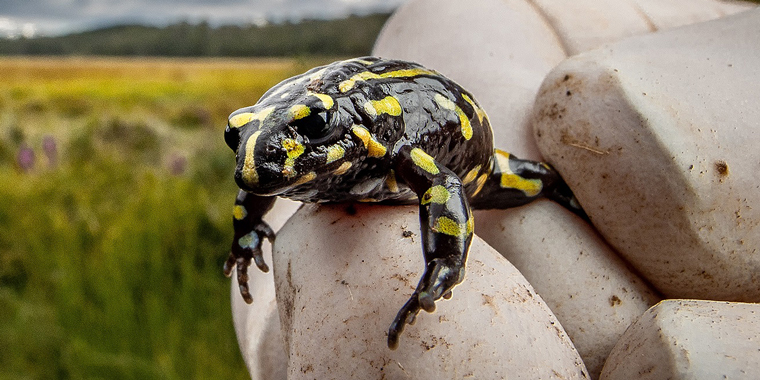
Weighing just 2–3g and only 25–30mm long, the brightly striped Northern Corroboree Frog is native to the alpine regions of NSW and the ACT and is listed as critically endangered, with only around 2000 adults thought to be in the wild.
Field ecologist Craig Dunne said, “This year’s survey results represent a major improvement compared with a decline we saw in 2023, when frog numbers dropped to their lowest levels and we thought we might see the species declining into extinction.
“In the hardwood estate three years ago just 60 frogs were recorded at 12 sites, compared with 390 frogs, which were detected this year.
“The increase we’re now seeing indicates the species has recovered from that low point with overall detections returning to levels comparable with earlier years. While some populations have remained small or stable, others that declined sharply in recent years have rebounded strongly,” he concluded.
Dunne said the findings highlighted the importance of long-term monitoring and the need to address a multitude of threats to the species.
“The Northern Corroborree Frog has historically declined due to the chytrid disease, but it also faces threats from climate change, blackberry encroachment and habitat degradation by feral horses, pigs, cattle and deer,” he said.
“As we have seen in previous years, disruption to the breeding season can set a population back for many years to come and can cause local extinction if the species can’t hold on until conditions improve. Although we have seen the species disappear from much of its former range, it is encouraging to see them remain stable in some places and to even come back from the brink in other places.”
Surveys conducted in softwood pine plantation areas of Bondo State Forest also delivered encouraging results, with 84 frogs detected, the highest number recorded in those areas since 2011.
“Detections were made at three new locations near pine plantations, which will be included in future surveys,” said forest information officer Madilyn Gavin.
“Finding frogs in areas where they had not been detected for some time highlights why it’s important to continue reviewing and expanding our monitoring network,” she added.
The enhanced count comes amid several programs designed to promote both Northern and Southern Corroboree frogs across the wider region. In Tumut and the Snowy Mountains, the Bugang Bila (previously Buugang Wambal) project, led by Walgalu and Wiradjuri people, has been working with various conservation groups and agencies to monitor and protect the frogs (including carefully mapping and excluding their areas from cultural burn trials).
Last month, a team comprised of Taronga Zoo Sydney, the NSW Government’s Saving Our Species program and the NSW National Parks and Wildlife Service released 700 Northern Corroboree Frogs into Brindabella National Park.
“This is the largest Taronga-bred Northern Corroboree Frog release ever undertaken for this critically endangered species,” said Michael McFadden, wildlife conservation officer at Taronga Conservation Society Australia. “We’ve learnt over the years of breeding and releasing and from scientific literature that releasing larger cohorts helps boost population success because more frogs survive early life challenges such as variable weather and disease.”
In addition to frog monitoring, Forestry Corporation surveys also recorded the endangered plant Pimelea bracteata, commonly known as the Scaly flowered Pimelea, with 74 individual plants observed.
MAIN PIC: The Northern Corroboree Frog is making a comeback thanks to the efforts of multiple conservation groups. Image: courtesy Alex Pike/NSW Department of Planning and Environment (2023)