Xylino shows LVL’s strength
A massive residential complex made of timber modules has just been completed.
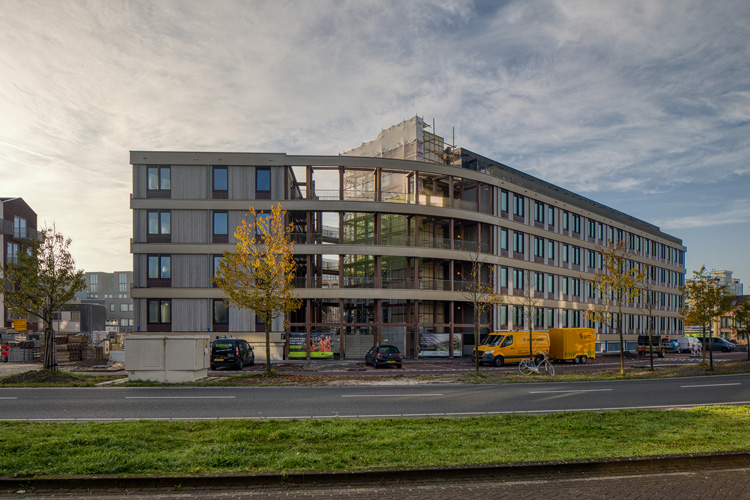
Despite the repeated modules, the building has individuality and charm.
Image: Marnix Klooster, supplied.
Constructed from Kerto LVL, the modules were standardised in shape but had wide variety in design. Image: Robert Aarts, supplied
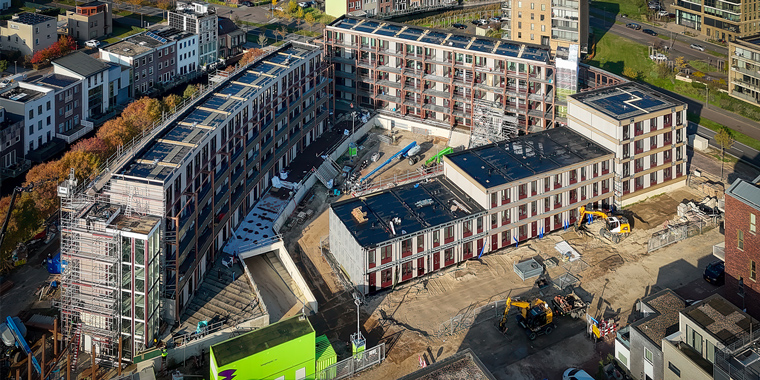
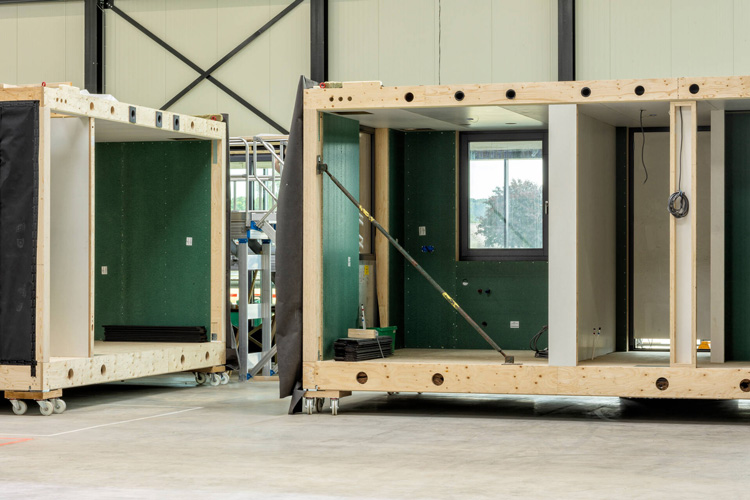
MAIN PIC: The modular design allows for a fast, almost Lego-like construction. Image: Marnix Klooster, supplied
Europe has long been a leader in modular construction and also has notable runs on the board when it comes to sustainable design for manufacture – and high-quality engineered wood products such as LVL. Which makes it a surprise to see how few builds bring these three factors together at scale.
In Almere, near Amsterdam in the Netherlands, a new five-storey residential complex called Xylino has done just that. The project takes its name from the Greek word for wood and represents the first large-scale modular housing development in the Netherlands built entirely from LVL.
Recently completed by property developer De Alliantie Ontwikkeling B.V., part of housing corporation De Alliantie, together with constructor Koopmans Bouwgroep, the building provides 103 homes, including mid-market rental units, social housing apartments and ground-level residences, supported by a semi-underground parking structure and a shared car-free courtyard.
The building is assembled from 436 prefabricated wooden modules manufactured by geWOONhout. Each module was delivered to the construction site with integrated technical systems. Built entirely from Metsä’s Kerto LVL, the structural system consists of four corner columns and integrated floor and roof elements. The interlocking assembly creates a strong and precise structure without the need for a concrete core.
Construction teams placed eight to 12 modules per day – three to four complete apartments. Every real-world component has a digital twin containing dimensions, specifications and end-of-life instructions. Each module includes a QR code linking to this data, supporting precise fabrication today and reuse or recycling in the future. The approach creates consistency in manufacturing while still allowing flexibility in layout and housing typologies.
Performance requirements for acoustic comfort and fire safety were key considerations. Lighter foundations reduced transportation emissions, smaller on-site cranes and PEFC-certified wood sourcing contributed to a significantly lower carbon footprint compared to conventional building methods. Modules are designed for disassembly, reuse and material recovery, supported by the integrated digital system.
Aafke Van der Werf, director of geWOONhout, said, “The best thing about Xylino is that you can’t tell from the outside that it was built using industrialised methods. To me, that proves that architectural freedom and modular construction can go hand in hand.”
With its combination of speed, circularity, comfort and performance, Xylino demonstrates that modular LVL construction can deliver affordable, high-quality housing at scale. Bas Broeke, project manager from Koopmans Bouwgroep, said, “This system is ready to be repeated. The way it works here means we can apply it in many more places.”