Taking an axe to forestry
Monday’s 4 Corners was a lesson in missed journalistic opportunity.
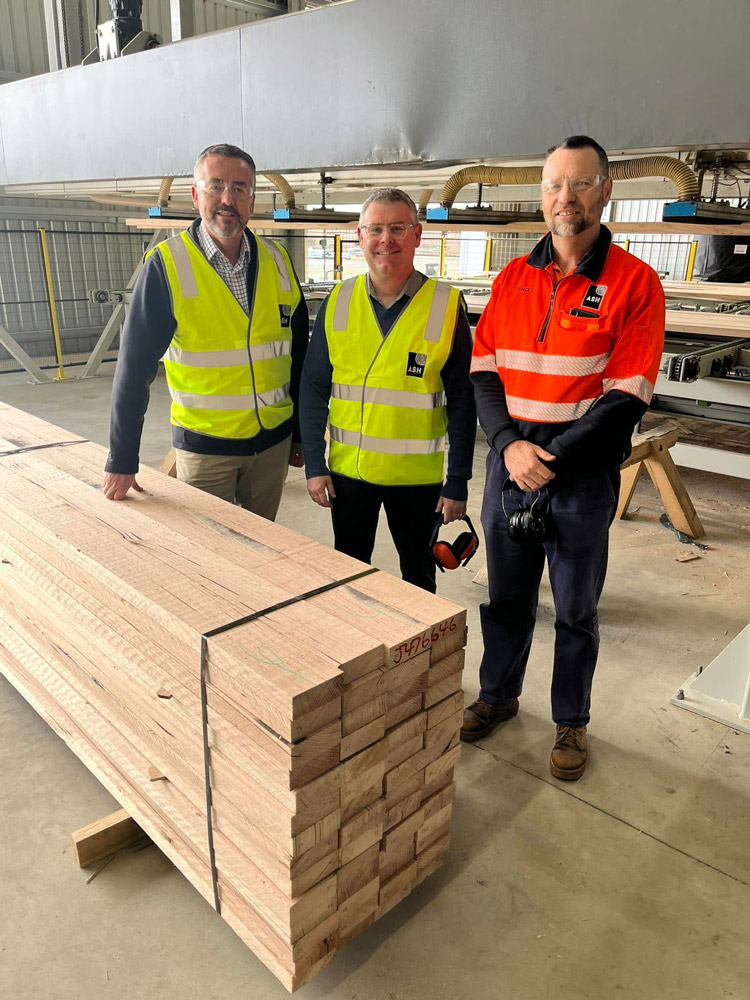
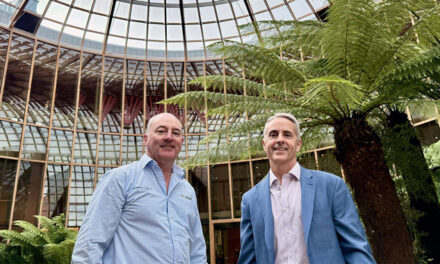
Australian Sustainable Hardwoods owner and managing director Vince Hurley (right) with Federal Member for Gippsland Darren Chester (left) and Senator Murray Watt. Image: courtesy Darren Chester
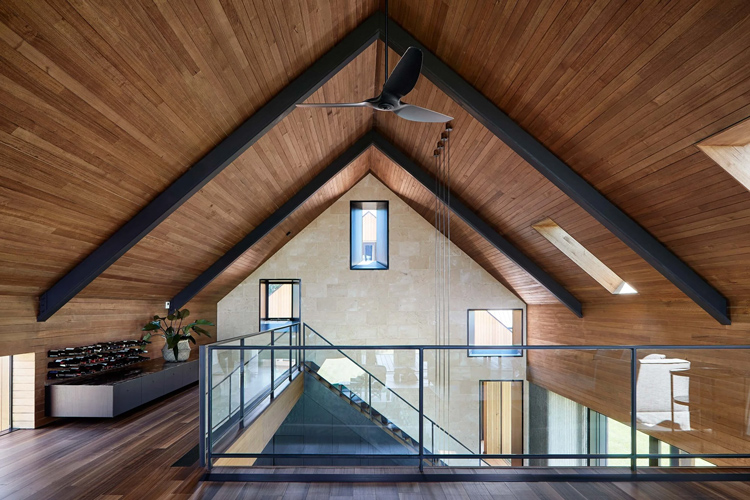
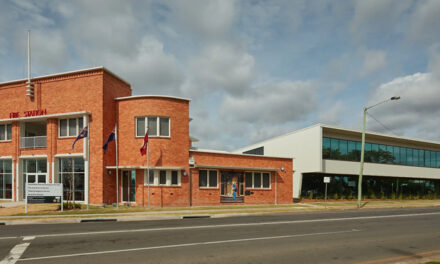
Tasmanian native timber made into high-value architectural lining boards by Neville Smith Forestry Products at Flinders Residence, designed by Abe McCarthy Architects. Image: courtesy Neville Smith Forestry Products/photo Shannon McGrath
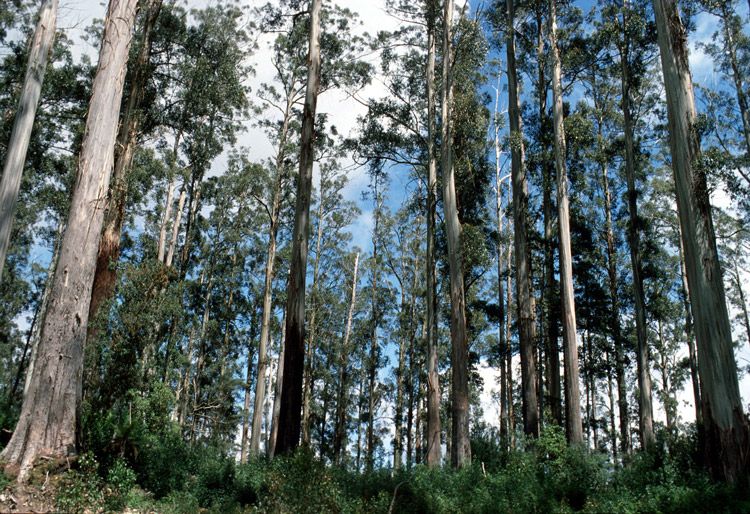
Mountain Ash (Eucalyptus regnans), one of the main contested native hardwoods in Tasmania. Image: CSIRO, CC BY 3.0
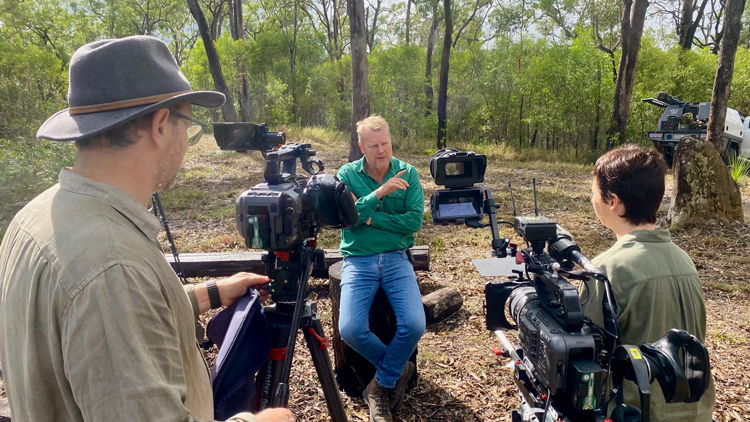
Timber NSW’s Andrew Hurford during his ABC interview. Image: courtesy Timber NSW
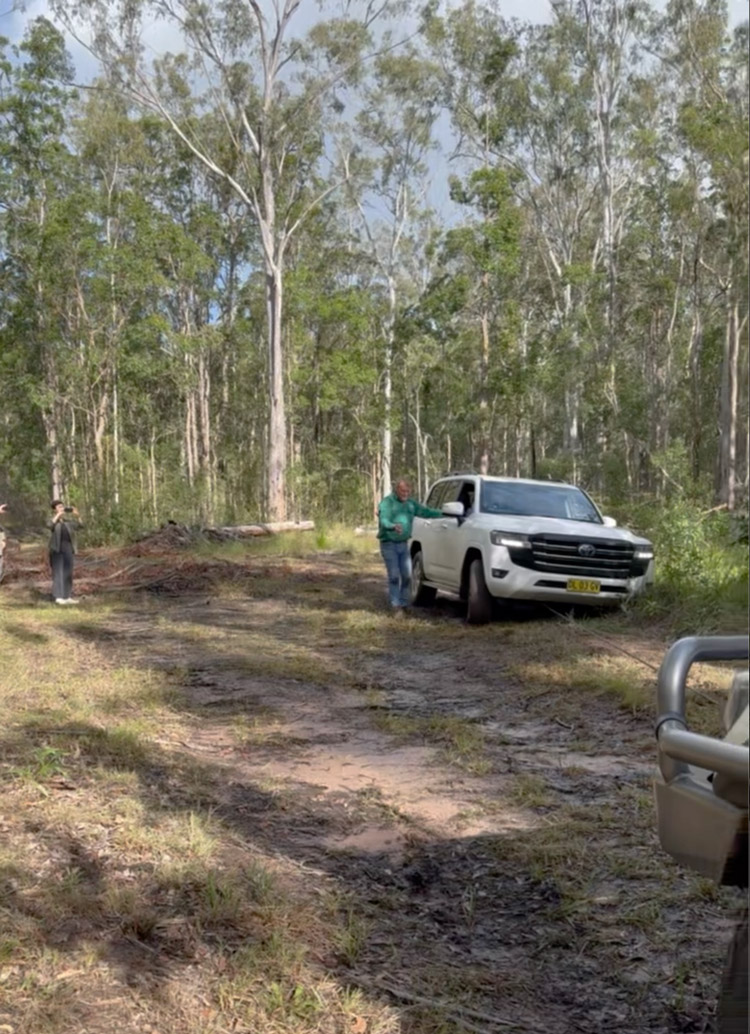
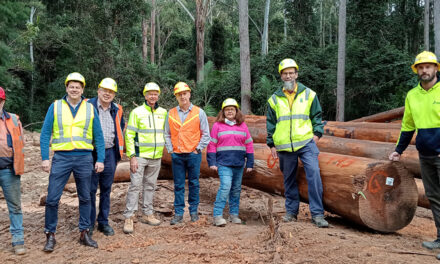
The ABC vehicle became bogged after the interview and Andrew Hurford stopped to winch them out. Jessica Longbottom is in the background filming. Image: courtesy Timber NSW
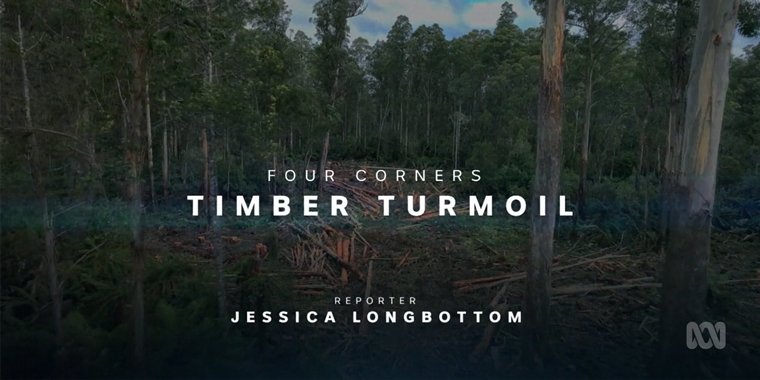
There’s a core lesson you’re taught as a baby journalist: don’t let yourself get in the way of the story. Which makes Monday night’s 4 Corners ‘Timber Turmoil’ report all the more disappointing. It missed the important and complex issues at the heart of Australian native forestry and their significant impacts on rural and regional centres, jobs, the economy and the future of the regional environment, instead accepting a line of argument put forward by environmental activists, even without the benefit of data.
Anger from the industry was palpable even before the program aired, with the adverts painting native timber harvesting in a negative light and allowing activist Green voices to frame the discussion. Sadly, for the majority of the actual report, that pattern was repeated. Rather than a dispassionate investigation of the costs, benefits and impacts of native timber forestry from environmental, economic or social positions, 4 Corners accepted the flawed premise that native timber harvesting is an environmentally costly practice that was only being limited in its rapaciousness by valiant activists.
Let’s take a closer look at some of the report’s flaws – and some facts that didn’t make the cut.
START WITH A SPIN
The story opened with “Across Australia, native forest logging has long been unpopular” and a clip of an anti-forestry protest. “And now, it’s losing political support,” added journalist Jessica Longbottom. This framing permeated the arguments that followed.
It is true that multiple polls over the past five years in NSW, Tasmania and Victoria have shown a majority of people calling for an end to native timber harvesting – overall numbers have been in the region of 55-70% against, 35-20% in favour of retaining the industry and 10% unsure.
It’s also true that polls taken in regions where native timber harvesting is actually carried out have returned the opposite result: a pre-election poll in Gilmore last year saw some 80% of voters, including more than half of those intending to vote Green, in favour of the industry continuing to produce high-grade products. All the above have been of smallish poll sizes, generally around 1000 respondents or fewer.
Back in 2023, the North East NSW Forestry Hub engaged StollzNow Research to look at public attitudes to native timber forestry a part of its Social Licence to Operate report. The report showed clearly that respondents who were more informed on the realities of native timber harvesting (including the small range of areas open to it, the regrowth cycles and the regulation governing it) were significantly more in support of the industry.
“Losing political support” is also hard to defend when Labor, the Coalition and even small parties like One Nation and the Shooters, Fishers and Farmers have publicly declared support for the sector, with only the Greens and some Independents committed to ending native timber forestry.
At the end of that introduction came the second major framing of the story: “While loggers have been forced out in one state, they’re now chopping down native trees in another. And it’s fuelled by taxpayer dollars that were meant to transition the industry out of this.”
An earnest young man (Hugh Nicklason, a forest campaigner for the Wilderness Society, Tasmania) gave his ‘message to the Victorian government: “Yeah, stop funding forest destruction down here in Tasmania.”
For ‘balance’, Longbottom concluded her introduction with: “The thing is: Australians love native forest timber … But now Australia’s running out of forest to fell … In this 4 Corners, we follow the logs and the money and ask whether there really is a future in native logging?”
Which would have been a great question to investigate. Alas, it was never asked.
MANUFACTURING A PROBLEM
The story proper began with a captivating character, former Greens MP Paul O’Halloran, driving after timber logging trucks through Tasmania. He believes the trucks are carrying native timber logs bound for Victoria and described “chasing” them.
The truck was followed to Western Junction Sawmill, which has supply contracts in place with Victoria’s Australian Sustainable Hardwoods (ASH), a company in which the Victorian Government holds a 49% stake.
While the report bounced between topics for visual impact, we’ll go through them in turn.
“One reason Victoria shut down native logging in state forests was that it was running out of places to log,” said Longbottom. “Most of the giant trees are long gone — due to fire, land clearing and logging.”
Technically that last part is true. But what she forgot to mention was the percentages. Fire has been number one in recent years. In terms of humans removing trees from the environment, forestry is a very distant fourth behind agriculture, mining (albeit now reduced in Victoria, but a major driver in other states) and development. Importantly, forestry replants the areas it has harvested, a fact ignored throughout the program.
Most of the native timber harvested in Australia is re-harvesting of previously logged areas, decades or a century after their first harvest.
As to the first part, Longbottom factchecked herself some three minutes later, noting that the Victorian government called a sudden end to native timber forestry thanks to legal challenges locking up the forest estate, not an absence of the forest itself.
Longbottom said, “The Victorian government paid 1.5 billion dollars to support the transition away from native forestry –and assist businesses affected by the shutdown. While some companies took the money and closed, others used it to stay open and source native timber elsewhere.”
Again, true, and a fact underlined by ASH’s managing director Vince Hurley, who makes it clear that a very significant proportion of the Victorian government money paid to the company was penalties as a result of cancelled contracts.
This segment opened in the town of Heyfield, where ASH’s mill is sited, chatting with multiple locals who demonstrated the mill’s centrality as a local employer and economic driver. Longbottom gave a brief history of the Victorian Government’s partnership with the company, discussing its $61.5 million investment in 2017-2021, an amount notably higher than that invested by the private partners who kept the company running, and other payments since.
“Yeah, the government outlaid more than us,” said Hurley. “And for them, they saw it as jobs. This business here, ASH, has created $400 million of economic activity, wages, government payments in the time it’s been here since 2017. Now, if that’s not a good investment, I don’t know what is.”
ASH purchased Western Junction Sawmill in 2022 to guarantee supply, a purchase that came “with an agreed government supply of logs from Tasmanian state forests and plantations”.
Longbottom missed important implications in this interview, even when she actually included the points. “ASH — the biggest mill in a state that’s ended native logging — now mainly survives on trees from Tasmania,” said Longbottom. “Half from plantation and half from native forests. It’s spent tens of millions of dollars upgrading its manufacturing operations, using low-grade wood to make high-value products like benchtops and beams.”
Having earlier taken time to inform the audience that 80% of timber logged in Victoria had been used for paper manufacture, this sustainable turn of events is completely glossed over. The fact that ASH has increased its plantation supply and uses native timbers bought in Tasmania to produce Masslam – a high-grade, significantly value-added engineered wood product (EWP) that is highly sought-after, allowing multistorey construction from timber and avoiding a huge percentage of the carbon cost for such builds in concrete and steel – was surely worth more than half a sentence.
Instead, Dr Daniela Juric, lecturer in forensic accounting at Monash University, was brought in to discuss ASH’s books. “It looks like an entity that’s struggling to stay afloat without the additional compensation from the Victorian state government,” she said.
Hurley reiterated that the Victorian Government had paid ASH significant penalties for failure to supply – not money intended to stop native harvesting, as Longbottom’s line of questioning appeared to imply – which ASH reinvested. He noted that the past several years had seen massive and expensive retooling for the company’s manufacturing division, which was very clearly paying off in its EWP sales. Using the penalty monies to fund those machinery assets has delivered another life for the business. He suggested that Longbottom sounded as though she was having a go at ASH for surviving and keeping its workforce employed.
“I am questioning the use of taxpayer money to prop up a business after the Victorian government banned native forest logging,” she said.
Hurley replied: “You need to ask the Victorian government why they banned native logging and therefore were liable for failure to supply payments.”
To give credit, Longbottom attempted exactly this, asking for an interview for weeks and finally pitching her question to the Premier at a press conference.
Premier Jacinta Allan replied that the government’s main focus was jobs, saying: “We’ll always look at ways to back workers, particularly in these small rural communities where companies like this one, they’re a big and important source of income and support for that area.”
At this point, you might be waiting to hear back from the workers relieved to still have their jobs in Heyfield. Don’t. We never saw them again.
THE CLAIM GAME
Back in Tasmania, against background shots that showed small logging coupes in large swathes of forest, Longbottom climbed onto a large tree stump, saying: “Giant trees like this one aren’t meant to be felled at all. The state forestry watchdog says logging contractors had to cut it down for safety reasons.
“When you look at this stump, it’s absolutely huge… One of the things that’s turned many Australians against logging is the felling of old growth trees like this.”
Rather than ask STT about those safety reasons, Longbottom again handed the floor to the Wilderness Society’s Nicklason, who said “These places around here, particularly in the Central Highlands, which should have been protected decades ago, are still being logged. That is ultimately partly being driven by Western Junction, ASH and the Victorian government.”
Longbottom did not ask how a mill purchase made four years ago had changed protection policies made decades ago, but she did ask whether the ownership of the mill had any real impact or if the timber would simply have found another buyer.
Nicklason replied: “The reality is, is that the industry has been on the decline for decades. So that demand should be going down.”
How activists impeding native forestry are meant to directly cause people to stop wanting hardwood benchtops is anyone’s guess.
Longbottom did push back on Nicklason’s claim native harvesting has increased recently, noting that “the state timber corporation denies any increase — and says harvesting levels have remained relatively consistent over the past five years. From next year the corporation will reduce the number of native logs it harvests and provide more plantation timber to sawmills.”
The story then returned to the log chasing it had opened with, showing whole logs being trucked onto the interstate ferry. O’Halloran and his equally charming colleague Patrick Johnson shared evidence of white-stickered whole logs from the Tasmanian public estate being shipped to Victoria for processing.
“Tasmanian authorities have repeatedly stated that whole logs from public forests stay in Tasmania — to keep jobs on the island. It says that none of these logs are from the public estate — and they’re all from private forests,” said Longbottom.
Representatives of Sustainable Timber Tasmania and Tasmanian Resources Minister Felix Ellis backed this claim up. However, both have since admitted this was a political preference, not law nor a defined contract term for supply.
Readers will recall that Tasmanian sawmillers were worried about this precise impact of Victoria’s exit from native forestry, with the penalty payouts from broken contracts being perceived as granting Victorian sawmills an unfair advantage. The ABC reported on this at length: click here for just one report from ABC Hobart’s Ellen Coulter.
The 4 Corners report suggested that these whole logs were traced back to Neville Smith Forest Products (NSFP) by them, but the written version of the story suggested it was a phone call from owner James Neville-Smith that solved the mystery. Whichever is the case, Neville-Smith made it clear his business had in no way violated its contracts, a position supported on Tuesday in media comments from STT and Minister Ellis.
Recently, the company’s Tasmanian facility has been converted to deal with plantation log only, meaning that NSFP needed to deal with its native hardwood log contract volume elsewhere. Most was sold to other Tasmanian sawmills and a small amount of native hardwood log consisting of mixed STT and private supply went to Victoria.
Longbottom gave Neville-Smith room to talk about the fact that hardwood products have to come from somewhere and Australia’s highly regulated industry is a better option than most overseas alternatives.
While she didn’t follow up on that point, she did clarify why his logs were being processed in Victoria, saying: “He says his shift to plantation in one mill means he can no longer process all his native logs — but that he still has to fulfil his contracts with customers for native timber products. So he is selling some logs to Victoria and they process them there. It’s not about making a quick buck, he says.”
The fact that this problem arose entirely because NSFP has been transitioning into 100% plantation timber was yet another discussion left out.
NOT A KOALA IN SIGHT
New South Wales was the last port of call for the story, opening with another charismatic environmentalist, out spotlighting for Greater Gliders. Scott ‘Sooty’ Daines, president of South East Forest Rescue, was very clear that the goal was to find as many gliders as possible so that native timber harvesting would be excluded from as many parts of the forest as possible.
In this section of the report, Longbottom came closest to actually interrogating the future of native timber forestry. Daines noted that he uploads his information on glider locations as soon as it is gathered, and that Forestry Corporation NSW adjusts their harvesting range accordingly. Longbottom added that the formation of the Great Koala National Park had removed 40% of wood supply in the north of the state in a single stroke.
Despite the passing mention of the GKNP, none of Dr Bradley Law’s koala research showing the animals do better in State Forests than National Parks was cited, nor were any recent population counts showing that multiple endangered species including the Greater Glider and Corroboree Frogs (see Enews #903) are doing well in NSW’s managed State Forests.
Longbottom’s final interviewee, Timber NSW’s chairman, Andrew Hurford, was given a couple of minutes at the very end to talk about the difficulties of operating against this level of activism, saying, “I think that we’ve got a rule set there which is, almost by design, trying to regulate the industry out of existence.”
He described the operations of his five timber mills, talking about how they source from both private and public estates and selectively harvest on a cyclical basis, though none of those terms were explained for the lay audience, nor the fact that the lush forest location for the interview was itself regrowth of recently harvested forest,
Hurford added, “I’d say there’s no other jurisdiction in the world that has a more complex or tougher rule set to operate under. I guess the question becomes, what is it that we want? The alternative, as we’ve closed more and more of our forests to productive forestry in Australia, what we have done is import more and more timber from overseas to fill that gap.”
Longbottom replied: “Well, I guess people are concerned about the environment and that’s what you’re up against.”
To which Hurford countered: “Yes, but they’re not concerned about the environment in West Papua or Solomon Islands or… which is where we’re transferring our timber production to.”
Frustratingly, this line of discussion was again dropped, with the conversation instead turning to hardwood plantations – Hurford’s comment that they require governments with long-term vision was only too depressing in this age of soundbite social media politics.
NOTABLE ABSENCES
In the final two minutes of the program, Longbottom said: “Across the country, native timber is being squeezed. For the industry — and the towns that rely on logging — it’s a fight for survival.”
Covering that fight would have made for a fascinating 4 Corners. Alas, not a single worker was interviewed, beyond one quick question in passing to a Heyfield resident as part of the introduction to Vince Hurley.
This wasn’t the only notable absence. In the whole episode, only one forest scientist was quoted: ANU’s Prof David Lindemeyer. Longbottom correctly identified him as “one of the industry’s foremost detractors”, which raises the question of why no other scientific voice was asked to respond to his claims and why data such as Dr Law’s work on koalas was excluded.
Lindemeyer was filmed in a Victorian forest logged in 2022, about which he said: “It hasn’t regenerated properly. It’s no longer a forest. What we’re really seeing is the creation of an ecological desert.”
Never mind that one of the consequences of Victoria’s sudden halt of native forestry was the end of VicForest’s seed collection, sowing and replanting programs, at a time when seed stocks were historically low thanks to Black Summer, and that DEECA, the replacement agency, is still getting up to speed.
Regional areas which rely on forestry as an economic driver did not appear in the program. No-one from Herons Creek was asked what will happen to their small town after mill job losses, nor were any of the consumers who buy the end hardwood products asked if they would rather buy their flooring or beams from less sustainable sources.
The broader economic case was also mostly missing. Hurley was able to show the huge return on investment the Victorian Government has received in keeping ASH jobs going, and Ellis was able to mention that forestry is a $1.2bn industry for Tasmania, but there was no wider discussion of the impact of native timber harvesting on the bottom lines of the States, nor Federally. There was certainly no calculation of the carbon costs of using native hardwood building materials rather than their high-carbon-cost steel, concrete and aluminium alternatives.
Despite three stalwarts of the industry being interviewed, timber sector voices were also mostly absent. In the 43 minutes run time of the program (ignoring credits), timber interests received only 11 minutes and 10 seconds: perhaps a few seconds more if you add the clips of STT staff in their committee hearing.
Instead, Longbottom focused on what my younger friends would call the vibes, foregrounding environmentalists who were clearly well intentioned but whose understanding of the issues was based on personal beliefs, not data. The result isn’t only skewed, it’s a missed opportunity, as those questions she asked but never answered are vitally important ones.
It’s particularly disappointing to see a report this lacking in balance on the ABC, as the national broadcaster has a long history of comprehensive reporting on the Australian timber sector, particularly on its Landline and regional radio programs.