NZ durable eucalypts: provide foundation for a robust tree breeding program
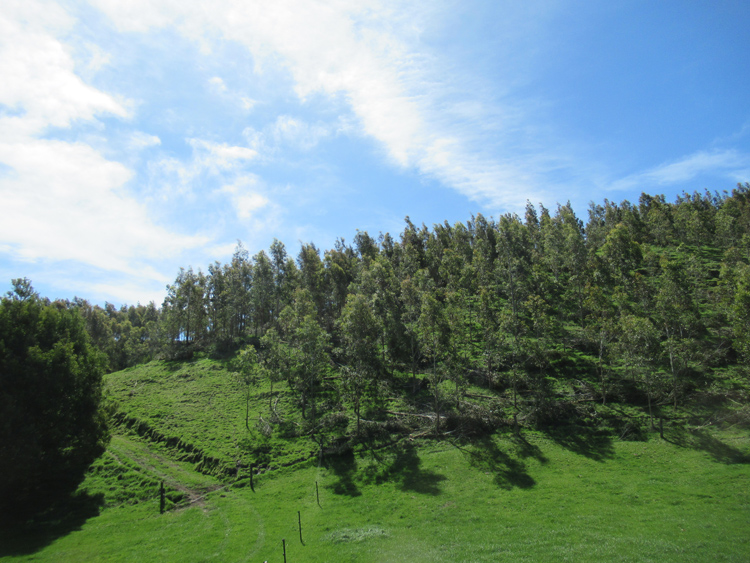
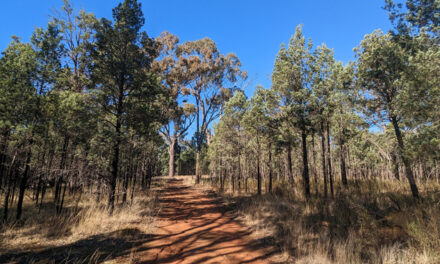
A recent thinning operation in one of NZDFI’s 2012 E. bosistiana progeny trials following a full growth and form assessment.
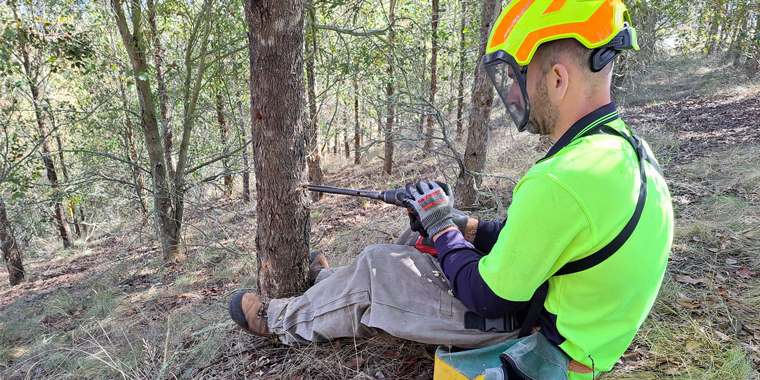
MAIN PIC: Milwaukee MP18CPD cordless drill mounted with coring tool used to collect core samples within 2012 E. bosistoana progeny trial. Images: NZDFI
New Zealand Dryland Forests Innovation (NZDFI) is looking to develop a multi-regional hardwood industry by planting 60,000 hectares of durable eucalypts sustained over 25-30 years.
Crucial to this development has been the NZDFI’s testing and breeding programme to achieve high quality nursery stock with genetic gain. The result is XyloGene®-branded improved seed currently in commercial production and for sale to nurseries and growers.
In a recently released technical paper (Selection and deployment of elite E. bosistoana for short rotation hardwood forestry), NZDFI’s manager Paul Millen (et al.) noted that, annually, the scale of regional planting programmes will require the establishment of around 2,000 ha and national production of 2-3 million seeds.
“Growers need to have confidence that their investment in new planting is going to be economically rewarding.
“Before NZDFI’s breeding programme began, durable eucalypts planted in New Zealand were unimproved, i.e. they were grown from seed collected from natural Australian forests or were the progeny of early New Zealand plantings.”
Eucalyptus bosistoana, coast grey box, was selected by NZDFI for genetic improvement, and has shown to be suitable/adaptable in many regions. It produces strong Class 1 durable timber with an expected in-ground service life of 25-plus years.
“The tree breeding cycle can take up to 20 years from testing a new forestry species through to commercial production of first-generation improved seed.”
The technical paper adds that “progeny testing is the fundamental activity in tree improvement … to calculate the breeding values of individual families and therefore identify the best genetics for further development and deployment.”
NZDFI planted more than 70,000 trees in a network of progeny trials between 2009 and 2012 to establish a first-generation, broad-based breeding population. “The E. bosistoana family seedlots deployed in these trials were sourced from mother trees growing across the natural range of the species from the central coast of New South Wales and south to coastal southeastern Victoria.”
The aim was “to provide the foundation for a robust tree breeding programme that applies well-proven scientific methods – combined with innovative technology – to deliver genetic gain across tree growth, form and wood quality traits for E. bosistoana”.
An important focus of NZDFI’s breeding programme is “to improve durable eucalypts suitable for plantations that produce small sawlogs, poles, posts and veneers on 15-to-20-year rotations. Some stem criteria are common across these products – for example, straightness and heartwood.”
Essential to progress is determining the taxonomic identity of the species to ensure genetic purity. “If a species is misidentified, there is a risk of unintentionally introducing genetic variability from another species or hybridisation, which can compromise the integrity of the breeding programme.”
Clonal seed orchards
Mr Millen says commercial seed production is a critical step in realising genetic gains from the program.
“Increasing improved seed production is best achieved through establishing clonal seed orchards (CSOs). CSOs are established with the top-ranked progeny-tested individuals (ortets) by collecting scions from these trees and grafting these onto root stock.
“This cloning process preserves the more mature physiological state of the scion and thereby promotes faster flowering in the orchard.”
A three-hectare CSO has been progressively established from 2016 by Proseed NZ at its Amberley (South Island) site – and the first crop of seed was collected from this orchard in 2020.
“Future production of improved E. bosistoana seed from Proseed’s clonal seed orchard will increase as flowering on the ramets in the orchard is enhanced by chemical application and from the addition of new selections from the 2010 and 2012 breeding populations.”
He adds that a recent evaluation of the 2012 progeny trials for growth, form and wood quality traits has identified the top-ranked 24 families among the 87 families established in the trial.
“This has been our main piece of work this year – and the next step will see Proseed grafting these families to expand NZDFI’s clonal seed orchard and ensure a high-quality XyloGene® seed supply to nurseries and forest growers. Proseed will collect scion material this month and graft new individual trees for planting in its Amberley clonal seed orchard in spring of next year.”
Webinar
Paul Millen (NZDFI’s Manager) and Ruth McConnochie (tree breeding consultant) recently hosted a webinar ‘Markets and tree breeding for short rotation durable eucalypt forestry’, and discussed the Australian hardwood market opportunity for NZ durable eucalypt growers and provided an update on NZDFI’s tree breeding program.